The World According To Cross
The ideas, theories, and crazy schemes presented herein are the sole perspective and opinion of the presenter, who encourages attendees and readers to seek out other perspectives and ideas, especially those that disagree with him, before deciding on a path for themselves. Cross is not an “expert” of any kind related to this practice and does not guarantee any particular result from its use. Play at your own risk profile.
Human Psychology
I have spent a lot of years on the academic side of brain study. This resource is part human psychology and personal study to help you understand some of the forces that are at work every day in your lives and the ways that you are training the people you spend time with, whether you know it or not, so that you can start to make those decisions in a conscious manner and start getting the results you want. This will not cover the top ten ways to punish a sub, or how to get around the masochism loophole. Punishment for masochists is it’s own complicated subject for another time.
This is about shaping behavior. It’s about what you can do to encourage the behaviors you want, and discourage those that you don’t. Using these tools effectively, you can fully change the way that a person acts, and not just when they are with you, but 24 hours a day. This resource will largely consist of me taking my knowledge of psychology and learning theory and applying it to the context of kink and D/s relationships. To that end, this is one of those areas that you really must negotiate and have explicit consent from your partners. Because meddling with a person’s personality is possibly the most extreme form power exchange, and in ethical BDSM we always get consent first.
That having been said, we train the people around us every day in subtle ways. A simple sigh or facial expression, depending on perception, can alter your partner’s behavior, even in vanilla relationships. Most people do this somewhat sub-consciously, so the idea here is to bring that out of the fog and help you to start doing it on purpose.
I want to point out the first section up above (labeled “The World Acording to Cross”). Any time that you attend a class or read a book, you are hearing just one idea, just one version of reality. I know people who have been teaching for decades and still attend classes regularly. Learning is a lifetime journey and there is always a new idea or a new perspective to consider. So, this will be the last disclaimer. I am not going to waste time throughout the rest of the text saying things like “In my opinion…” and instead just trust you to know that you are reading the world according to Cross and that you will go out into the web and find people who disagree with me so you can figure it out for yourself.
Kink As Therapy
For many people, exploring their sexuality and delving into power exchange can be very therapeutic. However, a dominant must resist the impulse to become their submissive’s therapist, even if they are trained to offer that service. For very good reasons, mental health professionals are strictly forbidden from treating family members or any one else they have a close relationship with. If you partner has issues which rise to the level of being a mental disorder or which would generally require a professional, then that is who they should be seeing to deal with those things.
The National Coalition for Sexual Freedom maintains a list of “Kink Aware Professionals” who can help you with counseling, medical, or other services. Many local groups maintain similar databases.
In the next section, I talk about lots of good reasons to engage in a training program. Mental health improvement is not among them. Please see a professional for that.
The Three Aims of Submissive Training and Development:
The first big question to ask is why you are trying to train a submissive in the first place. What is the goal, what are you trying to get out of it. Until you can answer that question very clearly and thoroughly, you should not turn the page or go any farther. You need to stop and spend time on this.
There are three major reasons or goals for submissive training.
1. Submissive Skill/Behavior Development
The first is general skill development. These are things that you will teach them or train them to do that are valuable beyond the reach of your particular relationship. Learning to give a kick-ass massage is not going to stop being useful when they are in service to someone else.
But in the same way, you do not necessarily have to be the person to train them for these skills. Especially if you are not qualified to do so. If you want your sub to have a particular skill, like cooking or cleaning or massage or manicure, there are places you can send them where someone else will do the training for you. They are called schools. And just about all of the techniques I am going to discuss are employed by effective teachers every day. But if it’s something too intimate to delegate to someone else, or if you happen to be qualified to teach it and want to do so, then you certainly can.
Examples:
- Household Management
- Personal Attendance
- Sexual Services
- Business Communication and Organization
- Event Coordination
- Interpersonal Skills
2. Dominant’s Individual Preferences
The second purpose of training is to teach things that are specific to you as the dominant. Now, unless you have a alpha slave or some other multi-tier D/s dynamic, chances are you are going to have to do all the heavy lifting on this one yourself. This is often the refinement of the broad skills from the first section. You can send them to yoga class to improve their flexibility, stamina, and endurance, but knowing exactly how far apart you want their knees to be when they kneel requires individualized teaching from you.
Examples:
- How they like their food prepared
- Their daily or weekly schedule and what you can do to help with it
- How much pressure they like during a massage
- What are their favorite fetishes
- Protocols, rules, and consequences
3. Personal Goals
The last section is stuff that isn’t objectively valuable to a specific dominant or to a partner in general. These are the things that the submissive wants to learn or change and has asked for help with. It could be getting rid of a destructive bad habit or staying on track with a project that has been neglected. It could be enforcing a diet or helping them make space for a hobby that calms them. These things are often neglected but are quite possibly more important than the other two sections. These are the things that will help make the D/s dynamic valuable to the submissive as well as the dominant. To make sure that they still feel like they are getting something out of the relationship.
Do not let those be forgotten
Examples:
- Things you are embarrassed that you can’t do well
- Eliminating a bad habit
- Abilities or skills that you are proud of
- Things that you always wanted to learn
- Abilities that will be useful in your future career
- Hobbies that keep you sane and focused
Identifying the proclivities of the submissive and determining the submissive’s role
This article is actually just one section from a larger document that we are thinking of making into a book. If you think we should make that book and would be interested in having a copy, please let us know here:
XCBDSM Book Interest Form
What does the submissive get out of the D/s relationship?
What fulfills them and drives their submission?
- Desire for Active Service – Active services are those things that the submissive does for others, such as cooking, performing oral sex, or managing the dominant’s schedule.
- Desire for Passive Service – Passive services are those things that the submissive allows to be done to them for the pleasure or benefit of others, such as flogging, sexual use, or body painting.
- Independence – To what level does the submissive desire to act on their own, without the direct instruction of the dominant?
- Selflessness – To what degree does pleasing or benefitting others motivate them?
These factors are used to determine:
- Whether you are compatible in a D/s relationship, and whether training is likely to result in a strong, positive relationship.
- The training approach that is most likely to yield success.
Not only do these factors need to be taken into consideration before starting a relationship, and on an ongoing basis as the relationship continues, but it also has to be given proper attention when you are thinking about beginning training of some kind. A person who derives great pleasure from being in service and making others happy is not going to need to be punished very often, if at all. However, if you are not careful, you can accidently punish them a hundred times a day without knowing it. If they do something for you and your facial expression doesn’t change or even exhibits something that could be interpreted as displeasure, they will notice it, even if not consciously, and they will change their behavior, stop doing something you like, simply because you were concentrating on something else and didn’t realize the feedback you were sending.
Similarly, a person may get fulfillment, not from the task itself, but from the control that task represents. This person is going to need more attention. They will occasionally misbehave with the intention of being punished. Not necessarily because they like the punishment, but because they are testing the dynamic. They need those reminders of the power exchange, and if you don’t provide it, they will seek it, often by acting out. It is your choice whether you let it get to that point or whether you are proactive.
And proactive is good.
What Is Conditioning? (Behavioral Learning)
OK, let’s talk a little bit about the word conditioning.
The definition of the word “Conditioning” is: “to bring (something) into the desired state for use.” That’s a great pre-packaged kink definition, isn’t it?
Conditioning is a behavioral process whereby a response becomes more frequent or more predictable in a given environment as a result of reinforcement, with reinforcement typically being a stimulus or reward for a desired response.
Conditioning is a form of learning in which either (1) a given stimulus (or signal) becomes increasingly effective in evoking a response or
(2) a response occurs with increasing regularity in a well-specified and stable environment.
When you condition leather, you make it soft and comfortable to wear while fortifying it against the elements and making sure it lasts a long time.
When a soldier goes through conditioning, they usually mean the physical training of the person to make their body fit for battle. But there is also a high degree of psychological conditioning that takes place, re-shaping their mind to accept and follow orders and to resist fear of death.
The same thing can be done with a submissive. And when we are talking about the psychological use of the word “conditioning”, there are two primary meanings.
Classical Conditioning
The first is “Classical Conditioning”. This is best understood using the example of Pavlov’s dog. The scientist rang a bell each time he fed the dog. After a while, the sound of the bell became entangled with the concept of food in the dog’s brain and whenever the dog heard the bell, it would begin to salivate. This is known as a conditioned response.
The really simple translation to kink is that if a particular toy is regularly used in conjunction with sexual pleasure, then the site or feel of that toy will eventually start to elicit a sexual arousal response, even if it is not a sexual toy. I know people who become aroused at the smell of rubbing alcohol because they associate it with play piercing and the hot hot sex that comes during or after the scene. This can be really fun when you go for something routine in the doctor’s office.

These physical conditioned responses can be used in a lot of ways. The really simple one is to simply speed things up. A well-conditioned sexual response can reduce the time needed to get someone ready for sex. Or can be used to tease and torment them in public. A negative association can also be used in place of punishment in a public place. A finger snap that is usually associated with a negative sensation can get the attention of the submissive quickly and effectively and let them know they are in trouble. Any and all senses can be used for this. Smell, touch, taste, sight, and sound. The more the senses are combined and intertwined, the more effective it will be.
When possible, you want the stimulus to be something they rarely encounter in day to day life. While the example I gave of the doctor’s office and the alcohol is funny, if the person worked in that environment, it would be very hard to overpower and override the association of that smell with the workplace and turn it into something else. Basically, you want as much control over the stimulus as possible. You want to be the only one, or practically the only one, that provides that stimulus. If you are trying to link a trigger word to their orgasm, it better not be a word they are hearing regularly each day, or it will never work.
Is everyone pretty solid on the concept of classical conditioning?
Operant Conditioning
OK, now for operant conditioning (BF Skinner 1930s). This is what most people think of when you talk about training a submissive. It is rewards and punishments.
Or, more accurately, it is everything that a dominant does which either encourages or discourages certain behaviors of the submissive, whether intentional or not.
This is your body language, your facial expressions, the words you use when you talk to them, if you use their real name or your pet name for them, whether you look at them while you talk, and pretty much every other thing you ever do, ever.
No pressure.
Operant conditioning is the use of consequences to modify the voluntary behavior of the submissive by associating certain choices and behavior with a defined set of consequences.
Like I said in the beginning, we all condition each other constantly. If you have a friend that is your first call on a bad day, it is because that person has trained you to expect a good result from making that choice while others have trained you to have lower expectations of them. When you see someone do something and say “oh man, my wife is going to kill me.” That is the result of a pattern of actions which have established an expectation of future actions. On a societal level, etiquette is trained into us early on. When someone holds a door and you say thank you without thinking about it, that’s conditioning. It can be subtle, subconscious, and totally unnoticed, even by the person doing it. But it is real and it is happening in every second of every day.
And it doesn’t take long, our brains are programmed to pick up on these patterns very quickly and adapt to them. In fact, before the end of the first day of classes, teachers can usually train a room full of students to comply with how they prefer to run the class, either with lots of questions and discussion, or silent note-taking.
See, your brain constantly collects information from others around you to determine what is expected of you and what you can expect from others. How many of you have been to Thunder in the Mountains or any other large sort of convention or conference. Ok, so you go to get your badge, you all go to the desk that has the first letter of your name on it. If there are other people there, you get into a nice orderly line and wait patiently until it’s your turn. No one has to tell you to do that. You just know that it is expected of you. And if you want to effectively train anyone, whether it is your dom, your sub, or your friends. Consistent actions which let them know what is expected of them and what they can expect from you is the way to do it. And you never have to say a single thing out loud about it. Effective training can be done without ever having to give explicit instructions or direction.
Now, lets dig into the big four.

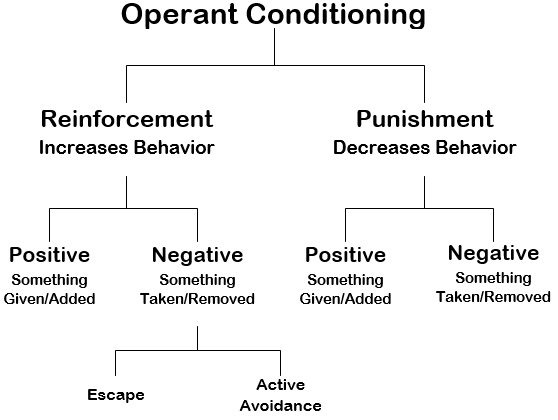
Reinforcement is a consequence that encourages a specific behavior
Positive Reinforcement (Reward): Providing a positive stimulus or other positive stimulus in response to a desired behavior. Ex: The submissive gets to have an orgasm if they keep the house clean.
Positive reinforcement. This is a pretty common term that most people are familiar with. Somebody does something you want them to do, you give em a cookie. Doesn’t have to be an actual cookie. With the right person, a smile can be cookie enough. The first time I said “Right?” and you said right, I thanked the first person who responded, gave them a little special attention. After that when you all responded, I said cool or awesome or great. Little verbal affirmations that you were doing what I wanted you to do and that affirmation reinforced the behavior, even with those who weren’t doing it yet. And over time, more and more responded. Positive reinforcement. Easy stuff.
Negative Reinforcement (Escape/Relief/Avoidance): Removing an averse stimulus in response to a desired behavior. Ex: Removing the chastity device for the evening if they correctly cook the meal you request. This can result in either direct response training (Whenever they here the annoying noise, they do a specific action to make it stop) or in active avoidance, where they perform the desired behavior to avoid the negative stimulus altogether.
The next one, almost everyone gets wrong. Negative reinforcement does NOT mean punishing someone for bad behavior. It means making a bad feeling go away as a reward for good behavior. It’s the dom who says, I am going to put these nipple clamps on you for the whole day until we get home tonight, but if you are very good and very attentive, I might take them off early. I gave a really overly simplistic example on the handout. You don’t like the way you smell, so you go wash, and now the bad smell is gone. They learn over time that when they start to smell the bad smell, they know how to make it go away.
And the person might even take the next step of, “If I wash often enough, the bad smell might not ever show up at all.” This is crossing the bridge to active avoidance. So in BDSM, that might mean that Fridays are nipple clamp day. If you are really good, they get to come off early. Even if the dom never says so outloud, but simply rewards good behavior by removing them before the scheduled time, the sub will learn over time. Then one day, the Dom says, “You know what, you have been SO good this week, I am not going to put the clamps on at all today.” Now this is new information, this is the bridge to active avoidance. If I am good all the time, not just Fridays, the sub has learned, than I can avoid ever having to wear the nipple clamps. And that is how you use negative reinforcement for training.
Punishment is a consequence that discourages a specific behavior
Positive Punishment (Punishment): Providing an averse stimulus in response to an undesired behavior. Ex: Shocking the submissive’s balls with a cattle prod when they speak out of turn.
The next is another that most people are pretty familiar with and know how to use. Positive punishment is a stimulus which discourages bad behavior. We are so lazy we set this one to auto-pilot with dogs now. The collars that spray citronella when the dog barks. Or the invisible fence that gives them a little electric shock if they go past a certain point in the yard. Yeah, that kinda stuff works on people, too. There are even products made for it. There is this little chastity device add-on that you can set to “dog-mode”. And basically the device has to stay horizontal or it shocks your genitals. Effective, I imagine, though I have not tried it myself.
Of course, this can be done manually as well. And the advantage of humans is that we can talk so the learning is faster. So I can tell you, if you do X, I will do Y, rather than just doing it and hoping that you pick up on it. But with some stubborn type people, the subtle administration of rewards and punishments without explicit acknowledgement can be more effective.
Negative Punishment (Penalty): Removing a positive stimulus in response to an undesired behavior. Ex: Taking away the submissive’s favorite sex toy when they forget to do the laundry.
Finally, we have negative punishment. This one is pretty straight forward, too. You’re grounded. No World of Warcraft for the rest of the week. You’re not allowed to use furniture for the next five days. No orgasms til June. Ok? Something that you like is being taken away from you, as punishment for bad behavior. It doesn’t have to be long term. It could be that we are playing or having sex and you say something that I don’t like, so the play stops. Fun time over. Yeah, that’s a negative punishment. Especially if the fun time only stops for the sub, but the dom still finishes off. That’s a lesson learned.
So, we should have that terminology straight now. Positive and negative don’t mean good and bad, they mean adding or subtracting. Positive is adding something and negative is taking something away. Reinforcement means that you are responding to good behavior, punishment means you are responding to bad behavior.
Does that make sense to everyone? Is that clear? Is there anyone who’s not there? Because nothing else will make much sense without it. Ok, moving forward.
REVIEW (BECAUSE IT’S IMPORTANT):
This article is actually just one section from a larger document that we are thinking of making into a book. If you think we should make that book and would be interested in having a copy, please let us know here:
XCBDSM Book Interest Form
Extinction:
Extinction is what happens when the effect of conditioning wears off. In classical conditioning, this is when the sound of the whip no longer makes them wet or the sight of the crop no longer makes them cry. If you go to long without enforcing the conditioning, it will stop working and their behavior will stop being influenced by it. The next big section is about how to make a plan for enforcement of conditioning in order to make it effective with minimal effort, while preventing extinction
.
Reinforcement and Punishment Schedules: The consistency/regularity of the punishment or reward
Unless you have a lot of free time, it is simply not possible to respond either positively or negatively to every single thing that a submissive does. Fortunately, you don’t need to. In studies of operant conditioning, researchers have found that behaviors remain influenced by a punishment or reward, even if it doesn’t happen every time. And in fact, it can sometimes be more effective and efficient to reinforce or punish on a schedule. Page 5 of the handout reviews some simple reinforcement/punishment schedule types, each with advantages and disadvantages. We’re going to look at those now.
Ratio Schedule: The reward or punishment occurs after a specific number of occurrences of the target behavior
The first is a ratio. This means that when the reward or punishment is given out depends on the number of times that the target behavior occurs. Continuous means a 1:1 ratio. Every time the submissive does a particular thing, they receive the response. If something is a high priority or if something is particularly new, this is probably the schedule you want, but as I said before, it will nearly impossible to maintain this for every single behavior you are targeting. So you have to reserve this schedule for special cases.
A fixed ratio says every 10 times or every 20 times you do the particular action, you will get a particular reward or punishment. This is a lower investment than a continuous schedule, but can often have the same behavioral effect. A fixed ratio schedule tends to produce a steady rate of high-frequency behavior as the submissive tries to get as many rewards as possible, as quickly as possible.
A variable ratio is saying that for every 100 times an behavior happens, they will receive 25 responses on average, but it won’t necessarily be every forth time exactly. This will feel like random enforcement from the submissive’s perspective, but so long as the frequency is high enough that the risk of punishment or potential for reward is stronger than the submissive’s preference for a different behavior, then it will still be effective. That’s why people gamble. Games of chance are designed to reward you just enough to keep you playing, but not too much that it becomes an expectation. In the same way, police attempt to have the bare minimum traffic enforcement to make people choose to drive safer but without committing too many resources to it. The intended mentality of the driver is, “I may not get caught this time, but eventually, if I keep driving this way, I will.”
o Continuous: The punishment or reward is administered every time the behavior occurs.
Example: Vending Machine
o Fixed Ratio: The punishment or reward is administered every nth time the behavior occurs.
Example: Car wash punch card. Your 10th wash is free!
o Variable Ratio: The punishment or reward is administered, on average, every nth time the behavior occurs, but not always exactly on the nth occurrence.
Example: Slot machine
Interval Schedule: The reward or punishment has a maximum frequency but is still conditional on behavior.
Now, an interval schedule, on the other hand, is time based, instead of frequency based. With a fixed interval, judgment for the administration of a punishment or reward only happens every so often. A great example is Christmas time with kids. Those two weeks before Christmas is the best behavior you have ever seen. Because there is that impending threat of Santa’s impending retribution hanging over their heads. But if you look on the chart below, you will see that the fixed interval has what we call a “scalloping” effect, where immediately after judgement day, the behavior stops improving, or even gets worse. If the weeks leading up to Christmas are the best behavior you ever see, the days after Christmas are the worst. But over time, there is a net overall improvement in behavior.
On a variable interval, the moments of judgment are not known to the submissive. You might say that their room will be inspected three times per week, but not tell them when. This can remove that scalloping effect and see a more consistent pattern of behavior. Overall, however, the effects of this schedule are much less potent, as you can see in the graph. This can be corrected by making the punishments and rewards greater.
o Fixed Interval: A set amount of time must pass before a reward or punishment will be administered after the previous reward or punishment.
Example: Free coffee with purchase, limit one per customer per day.
o Variable Interval: An indeterminate amount of time passes between a reward or punishment being administered, which is still conditional on behavior.
Example: Fishing. Checking email. Pop quizzes. Random drug tests.
Differential Reinforcement (DR)
Differential Reinforcement (DR) is the next step up form simple operant conditioning and schedules. It has two important characteristics, first that it emphasizes positive reinforcement over all others, and second that focuses on behavior related to the target behavior as well.
DR works to achive:
- A decrease in frequency of the target behavior (DRL)
- The absence of the target behavior (DRO)
- An increase in behaviors which prevent the target behavior (DRI)
- The substitution of a preferred behavior (DRA)
The reason that researchers emphasize this approach is that study after study has proven that positive reinforcement is a more powerful conditioning tool that yields more consistent results that are more resistant to extinction. Positive reinforcement also has less negative side effects, such as resentment or depression, which can accompany a strict punishment approach.
The approaches are positive in nature in that we find ways to use rewards to motivate the submissive to behave better (instead of punishing them for their present ways, which may have been ingrained over a period of years or decades). While punishments can be combined with these procedures to create a more powerful change program, DR procedures are often used without punishment procedures accompanying them.
Differential Reinforcement Of Low Rates Of Behavior (DRL) – REDUCE
Used to reduce a target behavior over time to acceptable levels by rewarding improvements (reduction in the behavior), even if the behavior is still present.
Example: A submissive who normally smokes 12 cigarettes a day is rewarded for each day that they only smoke 11. After a week or two, the number is reduced to 10, then 9, and so on until the behavior is eliminated.
Variations:
- Give bonus incentives for beating the set limit by a greater amount than required (e.g., displaying the behavior only 6 times when the limit was 9 times).
- Build in a clause in which going over the limit results in a penalty (the reward for meeting the limit is still in place).
Differential Reinforcement Of Other Behavior (DRO) – ELIMINATE
Used to eliminate a behavior by rewarding the absence of that behavior, regardless of what other behaviors are present. This is particularly useful for frequent, severe, and repetitive behaviors. Since rewards are given, even for different undesirable behavior, it should only be used for the elimination of high-priority problem behaviors.
Example: A submissive with a habit of calling people by their legal names at public events. The submissive is rewarded for each event where this does not happen, even if the other names they call them are not necessarily appropriate or polite.
NOTE: It will generally take a little while to see the initial benefit of this technique, but once it takes effect, the behavior will reduce drastically and quickly.
Differential Reinforcement Of Incompatible Behavior (DRI) – PREVENT
Used to reduce or eliminate a behavior by strengthening other behaviors that are incompatible.
Example: Reinforce a resting position of interlaced fingers in order to discourage fidgeting. Not because you (the dom) prefers that position, but simply because it prevents the alternative.
Differential Reinforcement Of Alternate Behavior (DRA) – SUBSTITUTE
Used to reward a specific alternate behavior in place of an undesired behavior.
Example: A new sub is rewarded for using the correct prescribed form of address for their dominant and others. They are punished for specific incorrect forms of address, such as use of legal names. And other forms of address used are ignored.
Process for Implementing a Training Program
Observe, Collect Data, Document
Do not trust your own memory or focus. If there is a behavior that you want to increase or decrease, you need to keep track of it at a base level. How frequently do they exhibit the behavior without reinforcement/punishment? Without this information, there will be no way to judge whether your actions are effective or notice if you are actually making it worse?
Make a Plan and Write it Down
Plans can be adjusted, but if you do not have a one in a place where you can review it and make adjustments as necessary, chances are you will lose track and fail to follow through.
Share the Plan with the Submissive (At least some of it)
It is not necessary to tell the submissive everything. If they know the whole plan of when schedules will be adjusted, etc., a smart submissive can manipulate the system to their advantage. However, at minimum, you want to tell them what behaviors are being targeted and in what way they will be published or rewarded. This will reduce confusion, anger, and resentment, as well as the amount of time that it takes for training to be effective. Nothing will make the training (and likely your relationship) fail faster than a submissive who knows they are being punished or rewarded but does not know why.
Implement the plan consistently and objectively
Don’t skip a punishment because they did something cute. Don’t reward extra because you are in a good mood. These techniques rely on using the submissive’s pattern recognition systems in the brain. If you divert from the plan and are inconsistent, those pattern recognition systems will draw conclusions and alter behavior accordingly. You may end up inadvertently reinforcing a behavior other than those you desire.
Observe, Collect Data, Document
Keep close track of progress. And make sure you let the submissive know that progress is being made, especially if punishments are being used or if the process has been a particularly difficult struggle for them. Special rewards for meeting certain benchmarks are a great way to boost the effect of your training program.
Adjust Often
This is different than being inconsistent. You have to be responsive to what is actually happening. Plan time throughout the training process to evaluate the progress and general state of both you and the submissive. If you are making progress on the target behavior but your relationship is becoming too distant and cold, than it may not be worth it to continue, at least in the same manner that you are. Making adjustments is appropriate and necessary in almost every plan. When your observations indicate an adjustment is necessary, return to step
Potential Causes of Failure:
Ineffective Reinforcement
The reinforcers aren’t reinforcing because:
They are not desired by the submissive
The ratio of task/demand to reward is too high
“Satiation” has occurred
The submissive became “bored” with the reward(for instance, given a treat every 5 minutes the submissive will eventually no longer be hungry or want any more of that treat.)
It is smart to vary the reward or provide options for rewards so that the submissive can select a reinforcer from the inventory that is of interest at that moment (i.e., Trading in points for items and privileges of various values).
Inconsistent delivery of reinforcers
The dominant forgot to administer them or the dominant has a busy schedule and often isn’t present to reward the behavior.
If you haven’t kept up your end of the bargain, you can’t expect your submissive to do so. You have been unpredictable and untrustworthy. You must instead be consistent in reinforcing appropriate behavior and punishing inappropriate behavior.
The submissive is unable to engage in the alternative/desired behavior
They may have a physical limitation that makes the alternate behavior not worth the reward. For instance, a bad knee can make a kneeling posture painful after a short amount of time, and a reward may not be enough to override that.
The behavior is too complex or advanced to remember without constant reference
Putting an entire 30 page protocol manual into practice all at once is unlikely to be successful. Effective training focuses on a few behaviors at a time and expands or builds on those behaviors once they are consistently and confidently performed.
The reinforcers were faded out too quickly
Avoid going “beyond the data”. Avoid increasing the work-to-reward ratio too quickly. Use continual observation to figure the correct time interval for reinforcement. If you’re using DRL, don’t lower the limit too quickly.
The reinforcers were faded out too slowly
Some submissives desire a challenge to their abilities. Failure to the adjust schedule to match their success has created a lack of contest. This problem can occur when working with two submissives at the same time, using the shorter of the two DRO time intervals. The submissive who could handle a longer time interval does not feel challenged.
“Generalization” to other environments/conditions was not promoted
It is important to help the submissive display the appropriate behavior under changing circumstances (e.g., staff members present, time of day, space/venue used) so that the correct behavior is displayed outside of a certain time and place. If all of your training is done exclusively in private in your basement dungeon,
A Few Last Things:
- Each of the issues below could be a long entry here onto it’s own. And if you search around, you will ind a lot of advice specific to each of these complicated situations.
- Consider your Submissive’s level of experience. Are they new To D/s or have they served a dominant before? Are they more experienced than you are? Newer dominants can learn a lot from seasoned servants.
- Consider your history together. Are they new to you or have you been together for years? Did you relationship begin with kink and D/s as a component or have you been a “vanilla” couple on equal footing up til now?
- Do they have other partners? Polyamory and open relationships are very common in the kink community, but they add extra challenges.
- Do they have a sub of their own? If so, to what extent does your control over them extend to that relationship?
- Do they have another dominant? If so, you have to be concerned with how that person’s training might be conflicting with yours. Are they in school? Do they have a job? Do you/they have kids? If so, then they have another dominant. Take that into account.
- Do you switch? If they see you bottom to someone, will it effect their ability to submit to you? Do you switch with each other? That can make dynamics complicated.
- Do they spend a lot of time with their parents or other influential people? How much do their friends influence their behavior? Do they undermine the better behaviors you are trying to enable.?
Training Without a Dominant:
One of the really interesting things about the world is that power exchange is everywhere, it just usually isn’t talked about explicitly. Personal trainers, coaches, classroom teachers, and bosses all take on dominant roles, and in many cases, you are paying them to do so. That’s because having someone to push you to be better is effective. As we addressed in the beginning, many of the skills and behaviors that will make a submissive more valuable to a potential dominant, or more happy with themselves and who they are, are available outside of a kink context. However, it often costs money to have someone you don’t know coerce you into doing things. A few books, like
The Submissive Activity Book, are available to guide a submissive through their growth without the presence of a dominant partner.
Conclusion
Way back at the beginning, we talked about these reasons, purposes, and goals for training. But now that we have talked about it and you are looking at the list, you may be wondering how to apply what we’ve talked about to some of these items. How to you apply reward or punishment to something as abstract as “household management”?
What you need to do is drill down from the larger skill set to individual, observable, trainable behaviors. So breaking down household management, that might include supervision of others, maintenance and cleaning, time management, and other things.
Then we take one of those, Time Management, and we break that down to individual components and so on until we find something that is trainable.
A good example for me is that I have a very bad habit of not adding things to my schedule and therefore not planning my time effectively. So a dom of mine might establish a rule that says that any obligations or plans have to be reflected on my calendar. There might be a variable interval schedule where my calendar is regular occasionally audited for accuracy and punishments and rewards are given out accordingly. It could also be a ratio situation where she counts the number of times that I am informed about a scheduled event and don’t immediately add it to the calendar.
Another on the list is sexual services. Drill down on that one and you may decide to focus your training on your male subs stamina during sex to both discourage early climax and encourage the physical endurance to perform for a certain length of time, or as long as necessary. You could use classical conditioning to build associations which either trigger or delay an orgasm. You could use positive punishment to respond to failures. But you could also use negative reinforcement on a fixed ratio system. The chastity belt comes off and you are allowed to orgasm only after the submissive has given the dominant a set number of orgasms.
I could keep going, but I think you have the idea. You simply deconstruct something down to a trainable behavior and then determine what type of conditioning will be effective and on what schedule.
Final Thoughts
And here, I will be a bit blunt.
This isn’t a game. This is serious shit. Psychological conditioning will have a long term impact on people. On the one hand, as I said, people are doing it to each other every minute of every day. It’s a huge part of how you came to be, how your personality was originally established. But when you engage in a program of targeted and intentional manipulation of this magnitude, you are taking on the full responsibility of their psychological well-being until the moment that one of you dies or until you put them back the way you found them. If you train them to cum only at the sound of your voice, then you are responsible for fixing that shit when you break up, or at least helping someone else do so. Because if you send them off on their own to try and have their next relationship and you have taken away their ability to experience pleasure, then you are the highest degree of asshole there is.
This article is actually just one section from a larger document that we are thinking of making into a book. If you think we should make that book and would be interested in having a copy, please let us know here:
XCBDSM Book Interest Form
Helpful Links:
Kink University – Online education from some of the best and well-known names in kink.
SubmissiveGuide.com – Mentoring, Self-Help and Submissive Exploration
One of the most comprehensive submissive resource and support sites I’ve ever found. Great for un-partnered submissives who wish to better themselves without a dominant.
Wikipedia:
Dominance and Submission
http://en.wikipedia.org/wiki/Domination_%26_submission_(BDSM)
Submissives (BDSM)
http://en.wikipedia.org/wiki/Submissive_(BDSM)
Operant Conditioning
http://en.wikipedia.org/wiki/Operant_conditioning
Classical Conditioning
http://en.wikipedia.org/wiki/Classical_conditioning
Recommended Reading:
Erotic Slavehood
The New Bottoming Book
Partners in Power
The Loving Dominant
DIRECT LINKS TO PURCHASE ALL OF THESE BOOKS ABOVE AND OTHERS ARE AVAILABLE FROM THE
BOOKSHELF PAGE